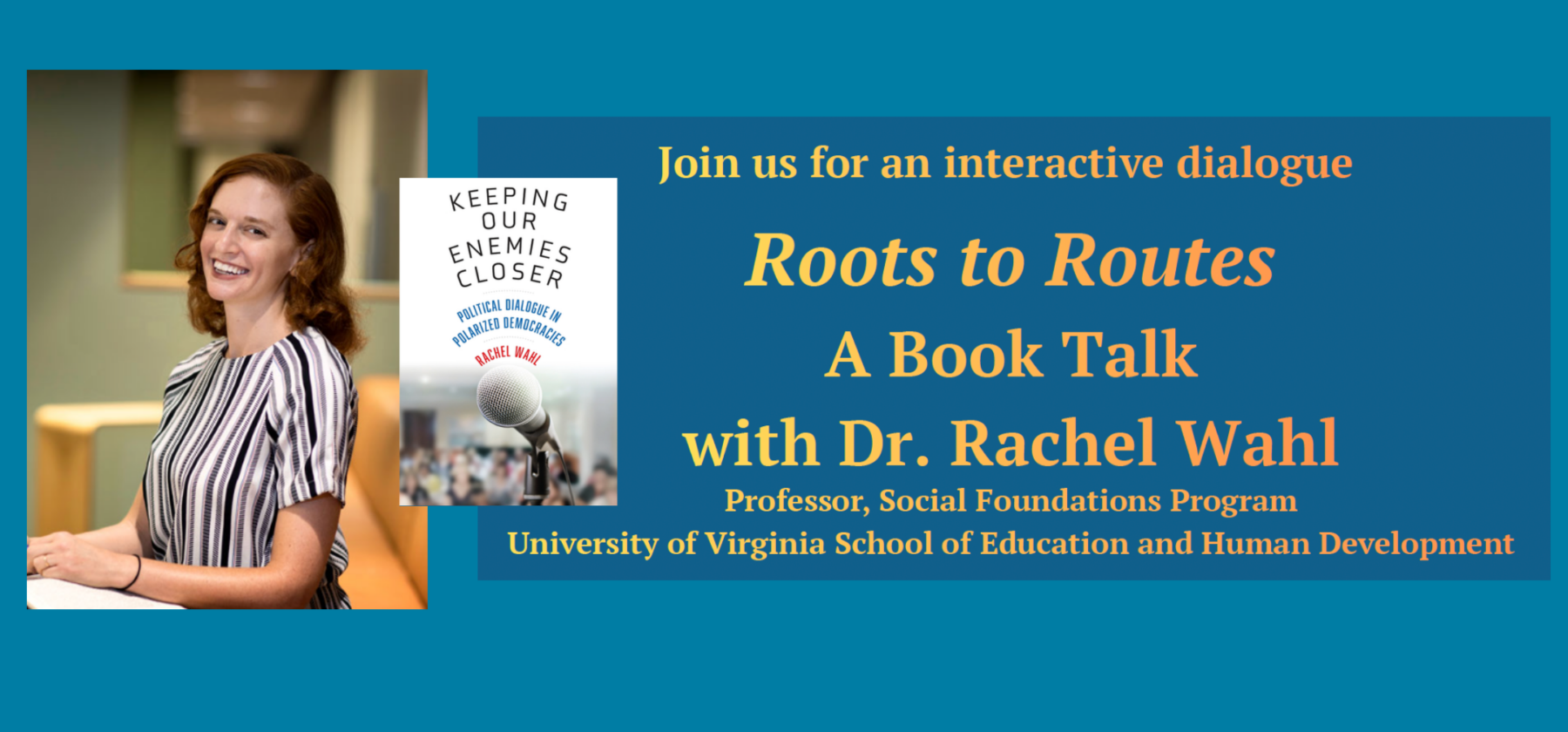
 We are so pleased to welcome Dr. Rachel Wahl to Penn, author of Keeping Our Enemies Closer: Political Dialogue in Polarized Democracies, for a lunchtime book talk event with Penn students, staff, and faculty.
Keeping Our Enemies Closer draws on years of original research with college students, community members, activists, and public officials to investigate what actually happens when people engage political opponents in dialogue. Challenging both the belief that dialogue can solve political polarization and the claim that dialogue is merely a distraction from justice, the book offers a nuanced account of the possibilities and limits of conversation in democratic societies.
Kindly RSVP as spaces are limited.
About the author
Rachel Wahl is Professor in the Social Foundations Program, Department of Leadership, Foundations and Policy at the University of Virginia’s School of Education and Human Development, where she studies democracy, political disagreement, and civic life. She is Director of the Good Life Political Project and a Faculty Fellow at the Karsh Institute of Democracy.
Wahl is the author of Keeping Our Enemies Closer: Political Dialogue in Polarized Democracies (University of Pennsylvania Press, 2026) and Just Violence: Torture and Human Rights in the Eyes of the Police (Stanford University Press, 2017), an innovative study of how police officers in India understand violence, justice, and human rights. Across both books, her scholarship seeks to understand how people make moral and political judgments in contexts marked by conflict, inequality, and competing visions of the good society.
Wahl’s research has been supported by major national organizations. Her writing has appeared in outlets including The Conversation and CNN, and she has been interviewed by NPR, public radio programs, podcasts, and national media on political polarization, democratic citizenship, free speech, and higher education.
At the University of Virginia, Wahl teaches courses on political dialogue, democracy, civic education, and the purposes of education. Through her research, teaching, and public engagement, she seeks to better understand how democratic citizens can sustain a shared political community without requiring consensus or abandoning deeply held convictions.