When most people walk into a university course, they expect lectures, debate, or at the very least, an implicit pressure to present the sharpest argument in the room. Academic settings often condition us to treat ideas like points to be won, using speed and theoretical vocabulary as proof of mastery.
In VLST 2140: Intercultural Dialogue and Perception—an SNF Paideia designated course taught by Claudia Tordini—the rhythm of learning is radically different. From the moment students engage with the material, they are asked to slow down, suspend immediate judgment, and step into something far more transformative: true dialogue mediated through visual art and experiential perception.
As part of the SNF Paideia Program at the University of Pennsylvania—which integrates dialogue, community, intentionality, humility, and curiosity—this course sits at a vital intersection. Drawing from philosophy, psychology, neuroscience, and art theory, the course poses a fundamental question: How can we engage across deep cultural, personal, and perceptive divides?

Beyond the Classroom: Immersive Learning Across Philadelphia
Dialogue cannot be mastered purely through lectures or theoretical readings; it must be embodied and practiced. Culture is ingrained in how we think and feel, so much so that our resulting beliefs and perceptions are instinctively shaped by it.
To support this, this course is designed as a blended, hands-on experience that moves fluidly between campus learning and immersive site visits across Philadelphia.
Throughout the semester, students engage with diverse spaces and artistic mediums:
- Museums & Contemporary Spaces: Half of the course meetings take place in institutions like the Philadelphia Museum of Art, the Institute of Contemporary Art (ICA), the Barnes Foundation, the Penn Museum, and the Pennsylvania Academy of the Fine Arts (PAFA) Cast Hall.
- Devotional Spaces & Cultural Landmarks: A dedicated tour takes students through spaces such as the Cathedral Basilica of Saints Peter and Paul, Congregation Rodeph Shalom, a Hindu Temple and traditional Japanese ceremonial space, exploring how architecture and devotional art shape cultural experience.
- Embodied Communication: Dialogue extends beyond the visual; students explore non-verbal communication and perception through movement practices like Argentine tango and improvisational acting.
In these settings, students practice tools such as the Klauckhohn framework to understand cultural values orientation, or the DIE model (Describe, Interpret, Evaluate) to catch themselves in the act of making instant judgments, learning instead to observe objectively before attributing meaning.

Art as a Neutral Third: Moving Beyond Argumentation
When talking about cultural identity or deeply held world views, its common for people to feel a bit hesitant or defensive—sometimes closing off curiosity before a dialogue fully starts.
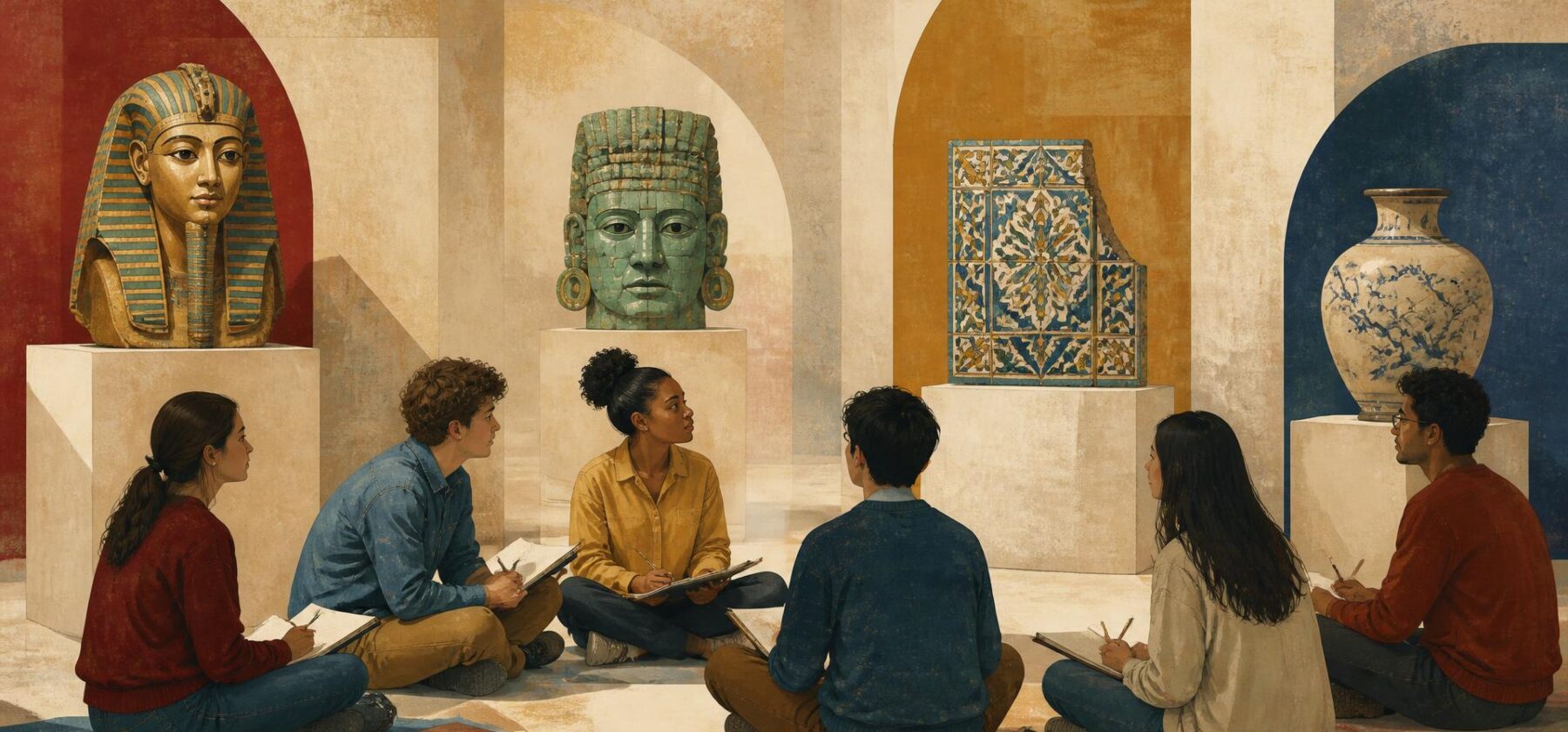
The course addresses this challenge by introducing art as a “neutral platform” or a third presence in the room. Rather than placing two people with differing backgrounds face-to-face to debate abstract concepts, the course centers an artwork between them to explore cultural differences and unconscious biases.
Art works as an extraordinary catalyst for dialogue because it does not demand a single “correct” answer. When students examine an artwork together, they move through distinct stages of observation and reflection:
- Observation and Description: Noticing the physical forms, colors, structures, and focal points before jumping to conclusions.
- Personal & Cultural Resonance: Uncovering how individual history, values, and cultural conditioning shape what they notice first—and what they overlook entirely.
- Exchange of Insights: Hearing how another person interprets the exact same visual stimulus, revealing the multi-layered nature of human perception.
By grounding conversations in a shared visual object, participants gain permission to inquire into complex cultural frameworks without retreating into defensive positions.
Redefining Dialogue: From Argument to True Connection
A central realization that emerges in the classroom is how easily we confuse everyday conversation or debate with genuine dialogue. In common usage, “dialogue” is often treated as a polite back-and-forth or negotiation. But guided by David Bohm’s framework On Dialogue—one of the core texts in the course—true dialogue is something far more profound.
True dialogue is a creative collective process. Active listening sparks a genuine, original reaction that when shared back and received through “active listening” by the other person, generates a back-and-forth exploration that takes a path of its own. It can be unsettling because of its “uncontrolled” nature but it can lead to a richer, collective new space. All participants of the dialogue are transformed because of it.
In true dialogue, differences in perspective are not obstacles; they are generative. When two individuals look at a piece of art and share their perceptions, they frequently discover that no two people see the exact same thing. One person might notice subtle tension in a painting’s composition, while another sees quiet harmony. When both views are shared without judgment, participants co-create a multi-dimensional understanding that neither could have reached alone.
Applied Learning: Unpacking Historic and Personal Dialogues
The practical power of this approach culminates in the course’s major deliverables, where theoretical models are applied to both personal growth and real-world failure.
For example, students examine famous historical breakdowns in intercultural dialogue, such as the high-stakes conflict between muralist Diego Rivera and Nelson Rockefeller over the Rockefeller Center mural. Working in teams, students dissect why the communication collapsed, analyzing the conflicting values, artistic vision, and ideological assumptions at play, before proposing how constructive dialogue could have altered the outcome.
The course is an eye opening for students who, sooner or later, discover a new, deeper way to look at art, uncover their own identity and biases, and learn a way to bridge the gaps across differences, whether cultural, religious, ethnic, or racial.
Cultivating Civic Competence for an Interconnected World
What makes VLST 2140 a quintessential Paideia experience is how directly its lessons translate beyond academic boundaries. The course requires no prior background in art or art history—only a commitment to self-reflection and open-minded engagement.
The skills cultivated—empathic listening, awareness of cultural biases, comfort with ambiguity, and the capacity to find common ground—are precise requirements for navigating modern civic life. By learning to see beyond the initial canvas, students build the capacity to see beyond their own assumptions, equipping them to foster meaningful connections in an increasingly complex world.
Claudia Tordini is an artist and instructor of VLST 2140: Intercultural Dialogue and Perception, an SNF Paideia designated course offered this fall. She is Affiliated Faculty in Visual Study and Organizational Dynamics Programs in the College of Liberal and Professional Studies at the University of Pennsylvania.
Illustrations in this article were generated with AI image tools and art-directed by Claudia Tordini, VLST 2140 — Intercultural Dialogue and Perception, SNF Paideia Program, University of Pennsylvania.