EngagePerspectivesFake News in the Post-Factual Era–It’s Not Just False Beliefs.

Fake News in the Post-Factual Era–It’s Not Just False Beliefs.

Inspired – if that’s the right word – by developments both in America and in my native Britain during the last decade or so, I’ve thought a lot about the nature of “post-factual” democratic politics.  So I was delighted to be invited to share some of those thoughts with an audience in Iceland, a much smaller and more homogeneous country than the two I know best.  It was interesting to see which of my observations resonated most, and least, in a place where many people follow American and British politics quite closely while also daring to believe that their own society can avoid the excesses of polarization, vitriol, and tribalism that they see across the North Atlantic, no matter whether they look West or East.  Disaffected and reactionary populism may not (yet) be a significant force in Icelandic domestic politics, but creeping distrust of experts does seem to be a problem.

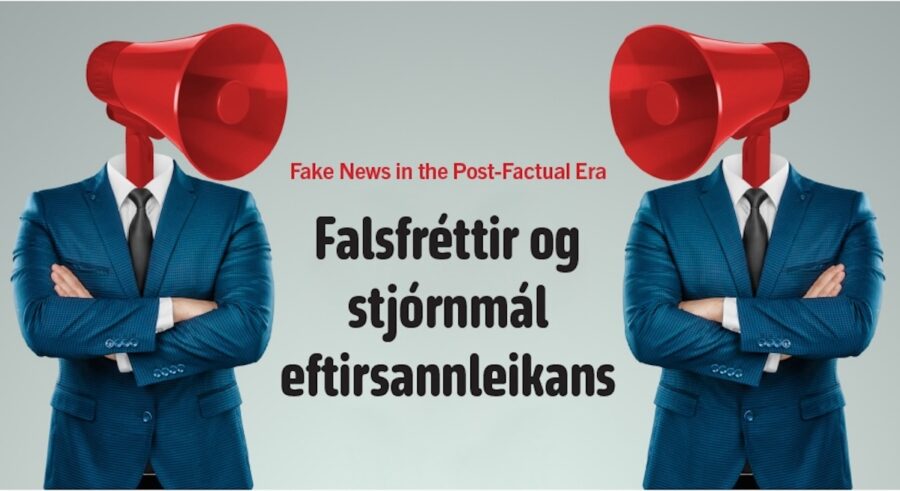
Fake news in the post-factual era
Fake News in the Post-Factual Era–It’s Not Just False Beliefs: The Many Faces of “Post-Factual” Democratic Politics.
Open Seminar at the University of Iceland by Ian MacMullen, Practice Professor of Political Science, SNF Paideia Program

My keynote speech for the University of Iceland’s open seminar on “Fake News in the Post-Factual Era” addressed the ways in which post-factual politics can be both consequence and cause of a tribal approach to politics, as people focus on identity – rooting for their team – either because they don’t care about the facts or because they despair of extracting those facts from the barrage of information and misinformation that technology unleashes on us all every day (and sometimes every minute).  I learned a lot from the expert responses to my talk – by a journalist, a media regulator, and a political psychologist – and also from the ensuing discussion with a highly engaged and knowledgeable audience.

And then, having done my best to promote three of Paideia’s four pillars (dialogue, citizenship, and service), I checked off the last one by attending to my own wellness, cycling along the paths that arc around the beautiful Icelandic coastline near Reykjavik.

To read the full story, “Media Literacy Important for Children, reported in English, from the Icelandic National Broadcasting Service, click here.
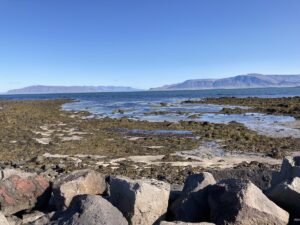
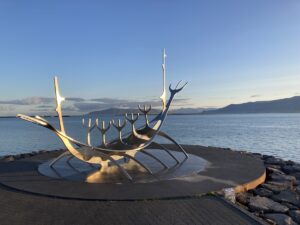
Views while cycling along the paths that arc around the beautiful Icelandic coastline near Reykjavik
Views while cycling the beautiful Icelandic coastline near Reykjavik.

Keep Reading

Blog

When the Camera Comes Out

There is a concept at the heart of the SNF Paideia Program called humility, defined not as self-deprecation but as a genuine recognition of… Learn More
illustration by Yuyi Morales from the book Dreamers, 2018 depicting woman with child putting together a book with colors of sand, oranges, pinks, and browns
Blog

Engaged in Dialogue and Dialogically Engaged: Dialogue as Both Genre and Mode

What actually is “dialogue”? Is it a thing that we do or a way that we do things?  We often talk about dialogue as a discursive… Learn More
Blog

Mind the Gap: On Diagrams in Dialogue

Is it altruistic if I help my friend move, because I don't want to study for finals? Students often arrive hoping to become experts in… Learn More